











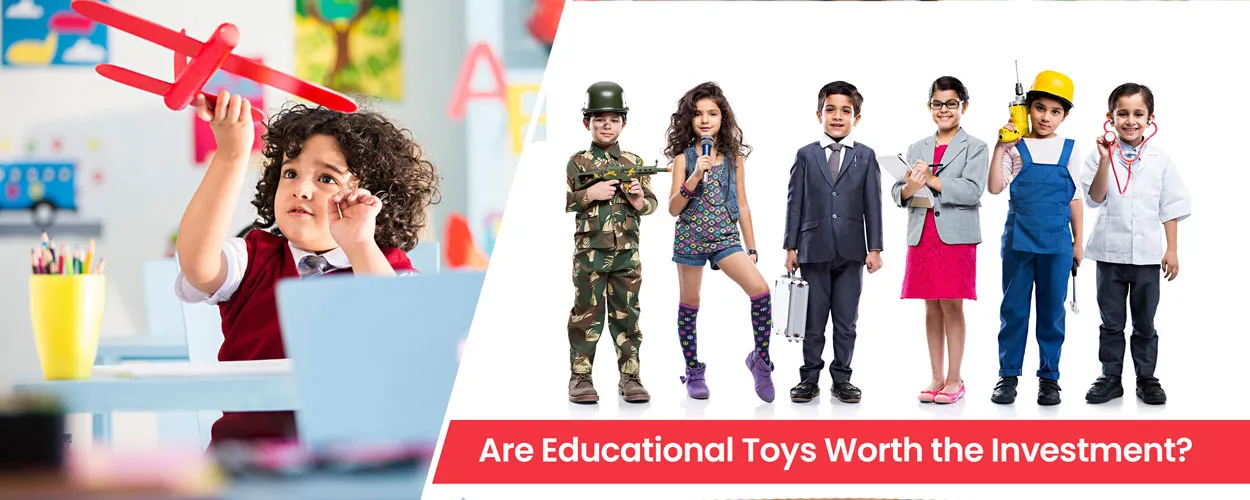
Are Educational Toys Worth the Investment?
Parents today are always on the lookout for the next way to give their child an edge. And in our fast moving society, they're looking to do it now. A whole new sector of the economy has opened up to serve this parental need, and it's called educational toys for kids. But do those toys really help? It looks at the case for and against educational toys and offers some guidance on what might work best for your child.
Understanding Educational Toys
Toys that educate are made to make learning happen in a world designed for playing. Some are simple (building blocks), and some are complicated (science kits). Even within their spectrum of complexity, all the toys have one common trait: educational value. All right, almost all. The toys exist for a wide variety of ages and developmental stages, and it would be surprising if there were not some for which the educational value was very high, some for which it was very low, and some for which we would really have to stretch our imaginations to see what was educational about them. So, the common use of "educational toys" may do more to mislead than enlighten.
The Benefits of Educational Toys
Toys that are educational pack a mighty punch when it comes to infusing children with cognitive, motor, and social skills. These narrowly define the scope of 'learning,' but in a very powerful way:
1. Intellectual Development
Educational toys challenge and stimulate a child's intellect. They encourage problem-solving, the kind of critical thinking that occurs when an act of creative invention is being performed, say, when a child is doing something slightly analogous to an adult engaging in a diabolical Rube Goldberg moment. I think of such toys as brainibles. Puzzles or games that test the child's mastery of strategies and that make them act as if they are using logic and shorthand to riffs on the weird kind of thinking that goes on in our brains when we are inventing, when we are being creative.
2. Improving Motor Skills
A vast number of educational toys are intended for children to work on their fine and gross motor skills. The very nature of the way different children play with these products and the experiences they gain from them allow them to work with their hands and nearly work with their hands across the continually diffusing spectrum of all actions and positions that make up human capabilities. In that context, the play is very varied. It ranges from simple hand use to finger and hand use in nearly all the positions that make up human capability.
3. Enhancing Social Skills
Frequently, academic playthings compel children to work with others, thereby cultivating the communication and teamwork skills future grown-ups must have.
Sharing, negotiating, and, most vitally of all, collaborating. That is how kids must use both educational toys and games if they are to gain the social skills needed to make the transition from being a child to being a productive member of society. And kids have to do it for a long enough time, often enough, that they almost don't think about it as something special or different. It has to seem ordinary.
4. Emotional Development
Toys designed with educational principles can aid children in feeling and empathizing with others. For instance, toys that facilitate role play allow children to experiment with all kinds of situations and get a handle on many different points of view.
5. Sustainable Worth
While potentially costlier, educational playthings can often seem to confer a kind of enduring worth that we might call sustainable. You can often play things that are fun and interesting for the kind of durational engagement it takes to make an experience seem like real play. And that's one marker of a plaything, it's fun. But fun isn't the only marker. Indeed, traditional toys can sometimes lose their luster shockingly fast and risk being cast aside in the way that juvenile beanies seem to have been. Educational toys, on the other hand, seem up for changes in format. They can work in a wide variety of contexts. And they seem to work in a wide variety of contexts for kids of a wide range of ages.
The Drawbacks of Educational Toys
Educational toys, although they have many advantages, possess some unfavorable traits. Consider these aspects, which parents should mull over:
1. Cost
Educational toys often come with a much higher price tag than the regular variety. They can be so costly, in fact, that some families might get into financial trouble simply trying to keep up with the demand for these supposed "must haves" for the child's development.
2. Overstimulation
Educational toys may be too much for some children. With demands placed upon them by parents, teachers, and the toys themselves, children sometimes need a quiet space to lie down and regain their composure. When the stimulation level is too high, some children will react with anger instead of using their problem-solving skills. When the toy in question is an educational one, it seems to defeat the purpose.
3. Limited SAPT
Even educational toys are not always used in a manner that makes it possible to identify failure predictors. Pretend play is not the kind of opportunity it should be for using these toys in a way that makes possible the identification of failure predictors. The demand is not unrestricted enough. And when pretend play is requested, it might mistakenly be seen as a demand for using the toy in a way that makes possible the identification of failure predictors.
4. Quality Is Not Assured
Just because something is labeled as a learning tool in the form of a toy doesn't necessarily mean it is one. Some supposedly high quality products just aren't, and even professionals can have trouble figuring out which are worth the cash. Parents must watch the purse strings if they are to ensure their kids are acquiring the kinds of products that lead to real learning.
Making the Right Investment
Parents should assess their children's exact requirements and strong enthusiasm when deciding if putting money into educational toys is a good idea. A few suggestions might assist in this judgment:
1. Evaluate Growth Opportunities
It is crucial to understand the stage of development your child is in. Choosing appropriate toys involves not just selecting those that complement your child's present abilities but also and especially picking those that will enable your child to reach new heights. A toddler might best be served with a shape sorter, but an older child could utilize a science kit in a much more engaging and enriching manner. You see, choosing the right toys is actually a very complex equation.
2. Prioritize Quality, Not Quantity
Focus on a small number of extraordinarily educational toys that provide a variety of fun and different learning opportunities. Avoid diving into an apparently endless sea of toys. Uncover the brand names that produce such toys, which are so educationally dense and durable that they're quasi-heirlooms. One excellent resource for tracking down such information is the website of The Toy Association.
3. Promote Play That Has No Specific Purpose
Select playthings that foster inventiveness and creativity. They should be open ended, yielding almost limitless possibilities for play and for learning. Such things allow children to pursue a variety of interests; to wander rather than take the straight and narrow path some of us adults prefer; to work at their own speed and, in the end, on what really matters to them.
4. Include Your Child in the Choice
Involve your child in the toy selection process. This collaboration can help ensure that the toys are in line with your child's likes and dislikes, which makes it more likely that the toys you have selected will be played with in an engaging way.
Conclusion
To summarize, toys that serve pedagogical aims can be a very good investment, returning a whole host of benefits that extend far beyond mere fun. They engage the neurons, and good old fashioned stimulation of the central nervous system is job one for any potential plaything. (No engagement, no benefit.) And they’re good for small and large motor skills, too, in a number of ways. They make you think about the future, and they also have you invest time and thought in the present. Still, as with anything, there are some caveats.
When weighing the decision to invest in educational toys, many parents contend the issue comes down to their personal finances and situations. They and their children have unique developmental paths.