











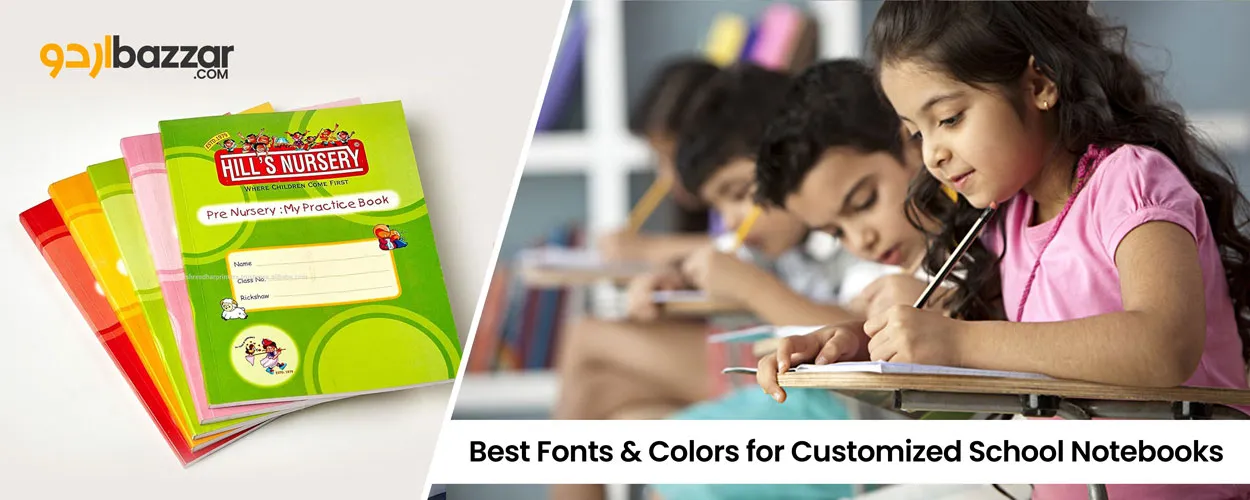
Best Fonts & Colors for Customized School Notebooks
Establishing a serviceable notetaking system starts with two decisions, both of which are far more complex than they might initially seem. First, you must choose between analog and digital tools. Then, you must select a specific tool from the chosen category. For both decisions, many factors should be considered, including cognitive, affective, and contextual elements, especially if your system involves customized printing for planners, journals, or templates tailored to your workflow.
The Importance of Fonts in Customized School Notebooks
Choosing the correct typeface is as important as choosing the correct font of a digital device. They affect the content in such a way as to think of them acting as a not so silent partner in the communicative act. The right typeface can enhance content and make it more engaging to the audience. Here are some typefaces to think about when making your decision.
1. Sans Serif Fonts
Numerous individuals prefer to utilize sans serif typography, like Arial and Helvetica, for their academic notebooks owing to the neat, modern look they provide. Sans serif fonts remain effortlessly legible, even at the notebook friendly size. And if you want your layout to look as close to professional and clean as possible, sans serif is the way to go.
The absence of serifs in these fonts makes for a typographic style that is nearly free of unnecessary or extraneous elements. And that is not only a visual plus but also a plus for your sanity when you are trying to read your own handwriting.
2. Serif Fonts
Fonts like Times New Roman and Georgia are serif fonts that bring an elegance and seriousness to personalized notebooks. Their designs are more for serious subject matter and have an old-world charm that gives our printed materials a sense of occasion. And though we don't often think about it, the small line or flourish at the end of each letter makes the materials more readable than a sans serif, all the more reason to go with a classic serif.
3. Script Fonts
Adding a personal touch is possible in the customized notebooks one might create by using script fonts. Brush Script and Pacifico, for instance, are two choices that could be used to add a creative flair to cover designs or headings. Of course, such choices necessitate being cautious. A font like the one used for Brush Script may be legible at a glance on a cover page, where a reader would expect only a very limited amount of text. These kinds of brushes with creativity, though, can alter the legibility equation in contexts where one might otherwise favor a typeface that is more text-friendly, like one in the serif family.
The Psychology of Color in Notebooks
The colors we choose can certainly provoke strong feelings. For when we see certain colors combined in particular ways, we're bound to be moved in some particular direction. Colors can lead us to take action, think outside the box, or just focus on some necessary schoolwork. Here are some ways to scheme and color your school notebooks.
1. Cool Colors
The "cool" spectrum colors like blue and green have well-established soothing qualities that make them ideal for academic settings. Of these two colors, blue is the more popular choice in the academic realm. It is frequently associated with trust and reliability, and it serves to not just create a calm atmosphere but also promote concentration.
Another color that is very frequently used and definitely popular in the academic realm is green. Its appeal in this context likely has a lot to do with how it relates to growth, both in terms of the literal sense (as in plants and other fresh, green items) and in terms of the personal development that we undertake in school.
2. Warm Colors
The warm colors are red, orange, and yellow. These are the very colors from which we get the most energy and enthusiasm. In subjects that demand high engagement, red is a color that stimulates the mind and makes it go into overdrive. On the other hand, orange and yellow aren't quite as mind blowing as red, but they could very well lend a sense of cheerfulness to your class.
3. Neutral Colors
Great backdrops for custom notebooks can be made from neutral colors like gray, beige, and white. These hues help to foreground design details, illustrations, or typography. They can also visually interest with some degree of backgrounding when paired with colors that have pop. And as far as giving a canvas to a more personalized design for the cover of a notebook, you can't go wrong with one of these.
Combining Fonts and Colors Effectively
When you are creating a personalized school notebook, it is beneficial to combine fonts and colors in such a way that they appear cohesive and are well-structured. Achieving this look can sometimes be a little tricky, so here are some suggestions that may help you.
1. Contrast is Key
Enhancing the differences in color between the text and background enables reading to be simpler. The first way to do this is to make the text darker. When the text is light and the background is dark, the message comes across clearly. You can also make the text bolder, like using a typeface that has a lot of heft, more or less equivalent to an upper case bold. Adding a serious amount of contrast between the type and the background is a good first rule for reading when you can't think of anything else.
2. Limit Your Choices
Keep a streamlined appearance; limit yourself to a few typefaces and colors in each design. One or two typefaces, rich with color, can still be a visually cohesive stunner. The reader can take it in without being overwhelmed. However, this is a delicate balance to strike.
3. Consider the Audience
When creating notebooks for specific educational institutions, the end users must be kept in mind. For the younger ones, don't use a type that is just too serious! They're not writing any sort of extended, academic work. Got a sort of design studio in the big kids of high school? Make their notebooks way better. Follow the principle of dialing in the design for the intended audience. Both user groups enjoy more function and far better looks.
The Impact of Personalization on Student Engagement
Notebooks meant for the school should not merely be digital or analog tools when it comes to the task of note taking. There should be much more. They should be reflections of the individuality of the student wielding them, and that, in my opinion, is the borderline that lies between a school notebook that can engender some ownership and pride and one that can also be seen as a vehicle for the student's personal artistic expression, of sorts. When we talk about personalization, which is a super-hot topic right now in design education, we aren't just talking about slapping on some stickers.
1. Encouraging Creativity
Allowing students to select fonts and colors encourages creativity and self expression. When students feel a resonance with their workbooks, they are far more disposed to use them nimbly, and they are far more likely to take authentic delight in the artifacts they conjure. This is a not so magic pathway to getting students to the place where they feel empowered to express themselves.
2. Building Identity
Notebooks can help students define one aspect of their identity when, with the help of their families, they select personalized designs that reflect their personalities. In this way, students are able to express something about themselves and what they value with the materials they bring to class. This is an underutilized opportunity to help increase confidence and foster a unique, positive space in which students can thrive.
Increasing your confidence in designing notebooks, as we often say, allows for much more likelihood to express something about your individual aesthetics and interior meaning, which might be a part of a truly positive learning environment. A classroom with Notebook Design Co. in it? Is any of us part of the aesthetics of that truly positive space? A classroom that doesn't exist.
3. Creating a Sense of Belonging
Students create a sense of togetherness at school when they have personalized notepads. They use these notepads for all kinds of more than private purposes. And when they talk with friends about the not so top secret designs they've inked on their notepad covers, they're using notepad personalization as a way to hang out and be with each other.
Conclusion
Without a doubt, the most important but underrated part of a notebook is its writing surface. The best kind of surface is a very special thing. A good surface is not only about being smooth; it is also about resistance and tactile feedback. It’s about how a pen meets a page, and how that page feels to the writer during the act of writing. It’s about paper that’s thick enough that you can flip it around without worrying that it will rip. When all else is equal, a notebook that has a good writing surface is an entirely different experience from one that doesn't. It feels better to use, and it feels more useful to use.